Contents
Last reviewed: 2026-07-20
Three Conditions, Not One
If gluten or wheat makes you feel unwell, you could be dealing with one of three different conditions: celiac disease, non-celiac gluten sensitivity, or a wheat allergy. They can look similar on the surface — bloating, stomach pain, fatigue after eating — but they are caused by three different processes in the body, and they are diagnosed in three different ways.
Getting the right one matters. The treatment for all three is avoidance, but how strict that avoidance needs to be, and what happens if you get it wrong, is not the same.
Celiac Disease
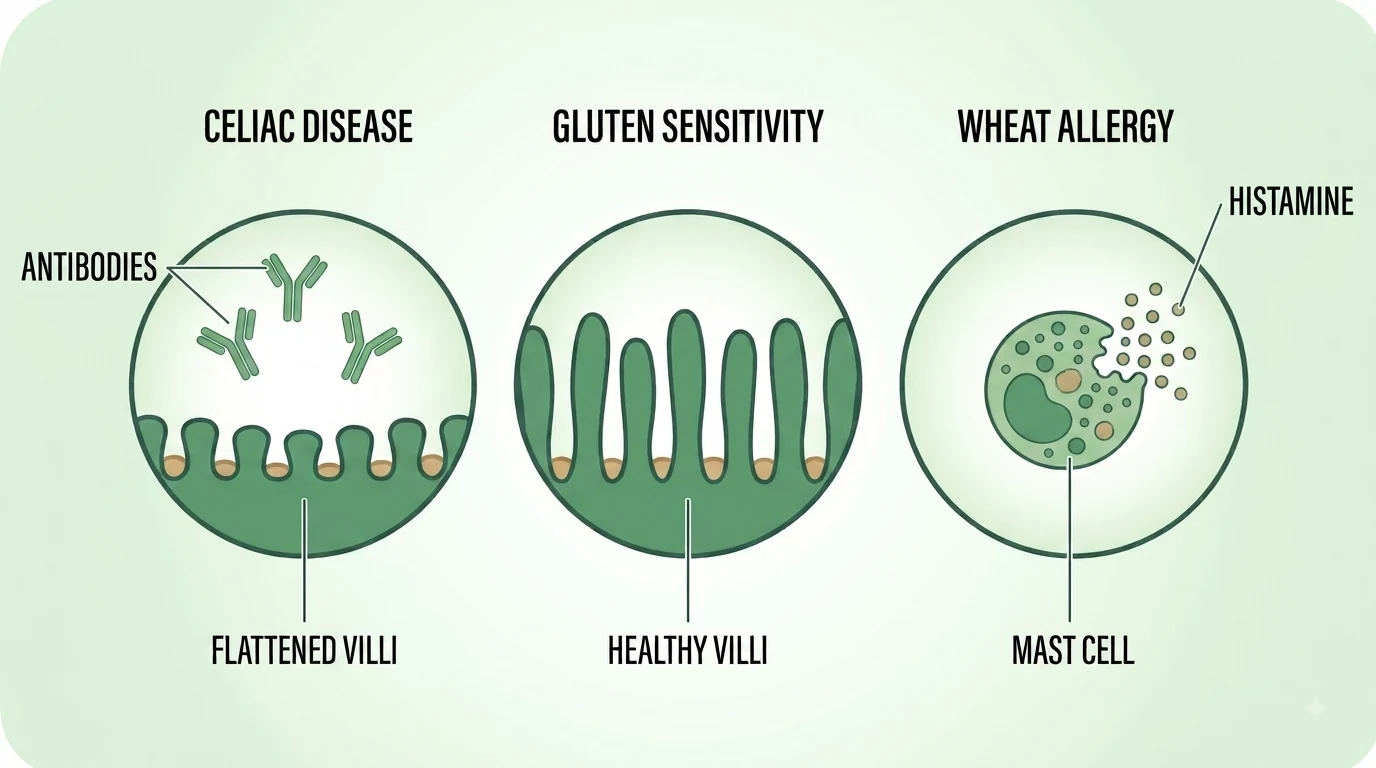
Celiac disease is an autoimmune condition. When someone with celiac disease eats gluten, their immune system mistakes it for a threat and attacks the lining of the small intestine. Over time, this damages the villi — the tiny, finger-like structures that absorb nutrients from food.
Left untreated, this can lead to real long-term harm: anemia, low bone density, and reduced fertility are all more common in people who keep eating gluten with celiac disease.
Celiac disease affects roughly 1% of people, though estimates vary depending on whether they come from blood tests or biopsy-confirmed diagnoses. It cannot be outgrown. It is a lifelong condition, and the only treatment is a strict, permanent gluten-free diet.
Non-Celiac Gluten Sensitivity
Non-celiac gluten sensitivity (NCGS) causes many of the same symptoms as celiac disease — bloating, abdominal pain, diarrhea, fatigue, headaches — but the underlying process is different, and still not fully understood.
- No intestinal damage. The villi are not attacked the way they are in celiac disease.
- No specific markers. There is no antibody or genetic test that identifies NCGS.
- Diagnosed by exclusion. Because symptoms alone cannot separate NCGS from celiac disease, it can only be identified after celiac disease and wheat allergy have been formally ruled out — and after symptoms are shown to improve when gluten is removed and return when it comes back.
How many people actually have NCGS is genuinely unclear, and estimates in the research swing widely — from around 1% to well into the double digits — largely because there is no lab test to confirm it. That uncertainty is part of the condition, not a gap in this article.
Wheat Allergy
A wheat allergy is a different kind of immune reaction entirely — it is IgE-mediated, the same type of reaction behind allergies to peanuts or shellfish, and it is not autoimmune. The immune system treats a wheat protein as dangerous and releases chemicals that cause an allergic reaction.
Reactions typically happen fast — within minutes to a couple of hours — and can include:
- Hives or a skin rash
- Swelling of the lips, tongue, or throat
- Stomach cramps, nausea, or vomiting
- Difficulty breathing
- Anaphylaxis, a severe, life-threatening reaction
A wheat allergy is specifically a reaction to wheat proteins. Someone with a wheat allergy does not necessarily react to gluten from other sources, like barley or rye — which is a real difference from celiac disease and NCGS, where the trigger is gluten itself, wherever it comes from.
Wheat allergy is more common in children than adults, and roughly two-thirds of children with a wheat allergy outgrow it. Adults who develop a wheat allergy usually have it for life.
How Each One Is Actually Diagnosed
- Celiac disease: blood tests for specific antibodies, usually followed by a small intestinal biopsy to confirm the diagnosis. In children, European guidelines allow a diagnosis without biopsy in some cases, when antibody levels are very high and confirmed by a second test — this pathway is not standard for adults. You need to still be eating gluten for these tests to work. Going gluten-free before testing produces false negatives and can cost you a diagnosis.
- Wheat allergy: an allergist evaluates you with a skin prick test, a blood test measuring IgE antibodies, or both. If results aren't clear, a supervised oral food challenge may follow. This should only ever be done under medical supervision, given the risk of a severe reaction.
- Non-celiac gluten sensitivity: there is no direct test. It is diagnosed only after celiac disease and wheat allergy are ruled out, based on your symptoms improving on a gluten-free diet.
Do not cut gluten or wheat from your diet before you are tested.
This is true for all three conditions, but especially for celiac disease: the blood tests and biopsy only work while gluten is still in your system. If you suspect a wheat allergy with any signs of a severe reaction — swelling, trouble breathing — treat it as an emergency, not something to self-diagnose at home.
Can You Have More Than One?
Yes. These conditions are not mutually exclusive. Someone can have celiac disease and a wheat allergy at the same time, or NCGS alongside a diagnosed wheat allergy. This is one more reason not to self-diagnose based on symptoms alone — a doctor needs to check for each condition on its own terms.
When to See a Doctor
If you consistently feel unwell after eating gluten or wheat, talk to a doctor before changing your diet. Bring a clear account of your symptoms and when they happen. Depending on what they suspect, they may refer you to a gastroenterologist, an allergist, or both.
Related Articles
- Recognizing Symptoms of Celiac Disease and Gluten Sensitivity
- Getting Tested for Celiac Disease
- Back to Gluten-Free Guide
Sources
- Serena G, D'Avino P, Fasano A. Celiac Disease and Non-celiac Wheat Sensitivity: State of Art of Non-dietary Therapies. Frontiers in Nutrition, 2020. https://www.ncbi.nlm.nih.gov/pmc/articles/PMC7506149/ — accessed 20 July 2026
- Lebwohl B, Ludvigsson JF, Green PHR. Celiac disease and non-celiac gluten sensitivity. BMJ. https://pmc.ncbi.nlm.nih.gov/articles/PMC4596973/ — accessed 20 July 2026
- Pinto-Sanchez MI, Bai JC. Toward New Paradigms in the Follow Up of Adult Patients With Celiac Disease. Frontiers in Nutrition. https://pmc.ncbi.nlm.nih.gov/articles/PMC6781794/ — accessed 20 July 2026
- American College of Gastroenterology / ESPGHAN. ACG Clinical Guideline: Diagnosis and Management of Celiac Disease (2023); ESPGHAN Guidelines for Diagnosing Coeliac Disease (2020). https://gi.org/guideline/diagnosis-and-management-of-celiac-disease/ — accessed 20 July 2026
- Beyond Celiac. Non-Celiac Gluten Sensitivity. https://www.beyondceliac.org/celiac-disease/related-conditions/ncgs/ — accessed 20 July 2026
- Gluten Intolerance Group. Celiac Disease, Non-Celiac Gluten Sensitivity or Wheat Allergy: What is the Difference? https://gluten.org/2019/10/15/celiac-disease-non-celiac-gluten-sensitivity-or-wheat-allergy-what-is-the-difference/ — accessed 20 July 2026
- Cleveland Clinic. Wheat Allergy: Causes, Symptoms, Diagnosis & Treatment. https://my.clevelandclinic.org/health/diseases/17717-wheat-allergy — accessed 20 July 2026
- American College of Allergy, Asthma and Immunology (ACAAI). Wheat & Gluten Allergy. https://acaai.org/allergies/allergic-conditions/food/wheat-gluten/ — accessed 20 July 2026