
Contents
Last reviewed: 2026-07-14
Why Testing Matters
A formal diagnosis gives you clarity about what is actually happening in your body. It lets doctors monitor you for related complications, it flags a risk your close relatives should know about, and it gives you access to specialist dietary care.
Going gluten-free without testing leaves the question permanently open. You may end up restricting your diet for no reason — or, worse, believing you are fine while damage quietly continues.
Keep eating gluten until testing is complete.
Going gluten-free before you are tested lets your antibody levels fall and your gut begin to heal. That produces a false negative and makes an accurate diagnosis much harder. If you suspect celiac disease, get tested first.
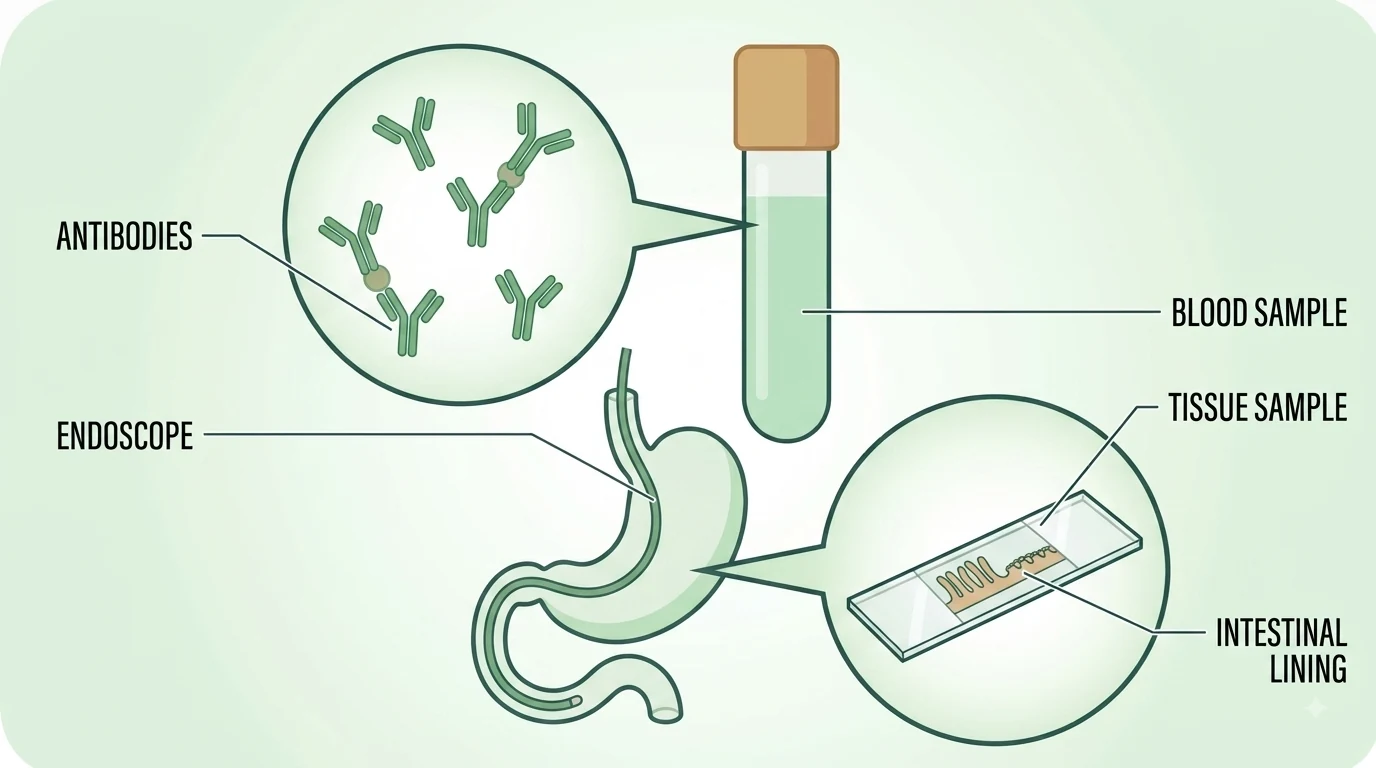
The Tests, at a Glance
| Test | What it measures | When it is used | The bottom line | |---|---|---|---| | tTG-IgA blood test | Antibodies your immune system makes in response to gluten | First-line screening | Accurate — but only if you are still eating gluten | | Total serum IgA | Your overall IgA level | Run alongside the tTG-IgA | Catches IgA deficiency, which would otherwise hide a positive result | | Endoscopy + biopsy | Physical damage to the small intestine | To confirm the diagnosis in most adults | The standard for a definitive answer | | Genetic test (HLA) | Whether you carry HLA-DQ2 or HLA-DQ8 | To rule celiac disease out | A negative result makes celiac disease very unlikely. A positive result proves nothing on its own |
Step 1: Blood Tests
Diagnosis starts with a blood test. The most widely used one measures tissue transglutaminase IgA (tTG-IgA) — an antibody the immune system produces in response to gluten in people with celiac disease. A raised level is a strong signal.
Doctors usually measure total serum IgA at the same time, and there is a good reason for it. Selective IgA deficiency affects 2–3% of people with celiac disease, far more than the roughly 0.1–0.2% seen in the general population. If you are IgA-deficient, your body cannot produce enough of the antibody the test is looking for, and the result can come back falsely negative. Where that deficiency is found, doctors switch to IgG-based tests instead, such as tTG-IgG or deamidated gliadin peptide (DGP) antibodies.
A positive blood test is a strong indication, but it is not a diagnosis on its own. A normal one does not completely rule the condition out either.
Step 2: Small Intestinal Biopsy
If the blood test is positive — or if celiac disease is strongly suspected despite a negative one — the next step is usually an endoscopy with a biopsy.
A gastroenterologist passes a thin, flexible camera through the mouth into the upper small intestine (the duodenum) and takes several small tissue samples. The procedure is done under sedation, is generally well tolerated, and is short.
A pathologist then examines those samples under a microscope, looking for damage to the villi — the finger-like projections that line the intestinal wall and absorb nutrients. Flattened or damaged villi, called villous atrophy, are the hallmark of celiac disease.
The "no-biopsy" pathway in children
In children, the biopsy can sometimes be skipped. European pediatric guidelines allow a diagnosis without biopsy when two conditions are met: tTG-IgA is at least ten times the upper limit of normal, and a second, separate blood sample tests positive for EMA antibodies. The decision rests with a pediatric gastroenterologist.
This pathway is not standard practice for adults.
Genetic Testing: A Tool for Ruling Out
Celiac disease is associated with two gene variants, HLA-DQ2 and HLA-DQ8. Almost everyone who has the disease carries at least one of them.
But so do roughly 25–30% of the general population, and the overwhelming majority of those people will never develop it. Carrying the gene is not a diagnosis. If you have taken a private genetic test and it came back positive, that on its own tells you very little.
The test earns its place the other way round. If you carry neither variant, celiac disease becomes very unlikely. That is what it is for: ruling out, not ruling in.
It is most useful for people who have already gone gluten-free before being tested, and for close relatives of someone with the disease.
Already Gluten-Free? The Gluten Challenge
This is the position many people find themselves in. They cut gluten, felt better, and only afterwards learned that the tests require gluten in the diet. Going straight to a blood test now would most likely produce a false negative.
The way back is a gluten challenge — deliberately reintroducing gluten for a period, so that antibodies can build again before testing.
There is no single agreed protocol. Celiac organizations and clinical guidelines genuinely differ on the dose and the duration. Broadly, they fall in this range:
- 3 to 10 grams of gluten per day — roughly one to four slices of wheat bread.
- Six to twelve weeks before blood testing, depending on which guideline is followed. Some protocols allow a shorter challenge before a biopsy.
The spread is real: research into shorter, lower-dose challenges is ongoing, and the guidelines have not converged.
Two points that every source agrees on:
- A gluten challenge should be supervised by a doctor experienced in celiac disease — someone who can move you straight to a biopsy if your symptoms become severe.
- Never undertake a gluten challenge while pregnant.
Do not design your own challenge from a web page. Take this to your doctor and plan it together.
Testing for Non-Celiac Gluten Sensitivity
There is no laboratory test for non-celiac gluten sensitivity (NCGS). It is diagnosed by exclusion: rule out celiac disease and wheat allergy first, then look for a documented improvement in symptoms on a gluten-free diet. Some clinicians confirm it with a formal double-blind gluten challenge, though this is not yet standard everywhere.
After Diagnosis
If celiac disease is confirmed, your doctor will usually refer you to a dietitian experienced in the condition. Follow-up blood tests are normally recommended to track antibody levels, which should fall on a gluten-free diet. A follow-up biopsy is sometimes recommended to confirm that the intestine has healed.
What This Means for Your Family
First-degree relatives — parents, siblings and children — carry a substantially higher risk. Estimates range from about 7% to 20%, rising to as much as 40% where the genetic match is closest.
Many of them will have no symptoms at all. That is not reassurance. Celiac disease is frequently silent, and intestinal damage can occur without any obvious signs, which is why testing is often advised for close relatives even when they feel completely well.
Related Articles
- Recognizing Symptoms of Celiac Disease
- Celiac Disease vs. Gluten Sensitivity vs. Wheat Allergy
- Back to Gluten-Free Guide
Sources
- Celiac Disease Foundation. Screening and Diagnosis. https://celiac.org/about-celiac-disease/screening-and-diagnosis/screening/ — accessed 14 July 2026
- Beyond Celiac. The Gluten Challenge. https://www.beyondceliac.org/celiac-disease/the-gluten-challenge/ — accessed 14 July 2026
- NIDDK / National Institutes of Health. Celiac Disease — for Health Care Professionals. https://www.niddk.nih.gov/health-information/professionals/clinical-tools-patient-management/digestive-diseases/celiac-disease-health-care-professionals — accessed 14 July 2026
- American College of Gastroenterology. ACG Clinical Guideline: Diagnosis and Management of Celiac Disease. https://gi.org/guideline/diagnosis-and-management-of-celiac-disease/ — accessed 14 July 2026
- HLA-DQ typing in the diagnostic algorithm of celiac disease. https://pmc.ncbi.nlm.nih.gov/articles/PMC4149591/ — accessed 14 July 2026