Contents
What Is Oat Flour?
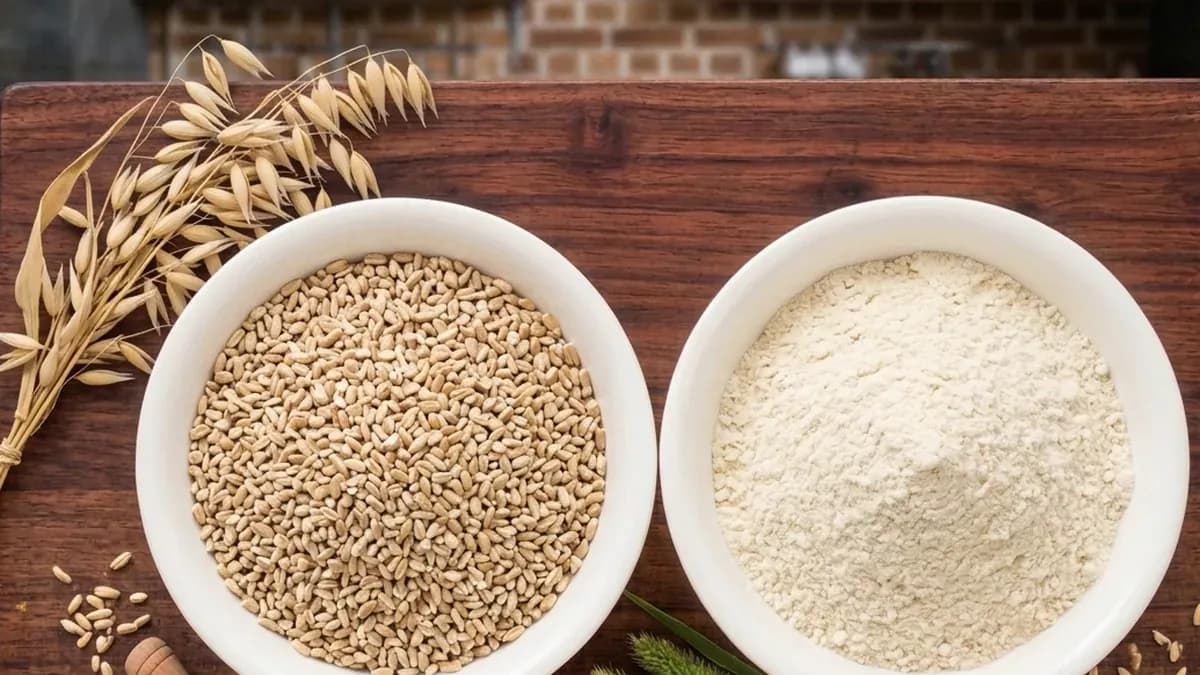
Oat flour is exactly what it sounds like: whole oats ground into a fine, powdery flour. It has a mild, slightly sweet, faintly earthy flavor that blends easily into baked goods without announcing itself. The texture is softer and lighter than whole wheat flour, and the color is a warm, pale cream.
One of the most appealing things about oat flour is how simple it is to make at home. Pour rolled oats (also called old-fashioned oats) into a blender or food processor, run it for about 60 seconds, and you have flour. The result is not quite as fine as commercially milled oat flour, but it works well in most recipes. Quick oats also work, though they tend to produce a slightly finer grind. Steel-cut oats are too dense and coarse for this method and are best left for porridge.
Commercially milled oat flour is more consistent in texture and is the better choice when a recipe requires a delicate crumb or when you are baking for someone with celiac disease and need certified gluten-free labeling on every ingredient.
Nutrition Basics
Oats are one of the more nutritionally dense grains available. Oat flour retains most of what makes whole oats valuable: it is a good source of dietary fiber, including beta-glucan, the soluble fiber associated with heart health and stable blood sugar response. It also provides protein, iron, magnesium, and several B vitamins.
For exact figures, see USDA FoodData Central.
Compared to refined white rice flour or tapioca starch, oat flour carries more protein and fiber, which contributes to a more satisfying result in baked goods. It is not a high-protein flour by the standards of wheat or chickpea flour, but it holds its own among the common gluten-free options.
Oats do not contain gluten in the clinical sense. The storage protein in oats is called avenin, which is structurally distinct from the gliadins and glutenins that make up wheat gluten. For most people this distinction is academic, but for people managing celiac disease or gluten sensitivity, it matters considerably. More on that in the cross-contamination section below.
Baking Behavior
Oat flour behaves differently from wheat flour in a few important ways, and understanding those differences is the key to using it well.
First, oat flour is absorbent. It soaks up liquid readily, which means batters and doughs made with it can thicken as they sit. If a batter seems thin right after mixing, wait a minute or two before adding more flour. Conversely, if a recipe converted from wheat flour produces a stiff dough, add liquid by the tablespoon until it loosens.
Second, oat flour produces a soft, tender crumb. This is one of its best qualities and the reason it is so well suited to cookies, muffins, pancakes, and quick breads. The texture is moist and slightly dense without being gummy, and baked goods made with oat flour tend to stay soft for longer than those made with rice flour alone.
Third, oat flour does not provide structure on its own. Because avenin does not form the elastic network that gluten does, baked goods made with 100 percent oat flour can be fragile and prone to crumbling. Eggs help considerably. So do xanthan gum, psyllium husk, and ground flaxseed mixed with water. For most applications, blending oat flour with another gluten-free flour — tapioca starch, potato starch, or almond flour — produces a more stable result than using oat flour alone.
Oat flour also browns readily, which is an asset in cookies and a thing to watch in cakes. If a cake recipe using oat flour seems to be browning at the edges before the center is set, tent it loosely with foil and lower the oven temperature by about 25 degrees Fahrenheit.
Substitution Ratios
Oat flour cannot simply replace wheat flour at a one-to-one ratio in every recipe, but it is one of the more forgiving gluten-free flours to work with.
For cookies, muffins, and pancakes, replacing up to 25 to 30 percent of the total flour with oat flour is straightforward and generally requires no other adjustments. The result will be slightly softer and moister than the original.
For recipes that are designed specifically for gluten-free baking, oat flour often works as a direct swap for other gluten-free flour blends at a one-to-one ratio by weight. Volume measurements are less reliable because oat flour is lighter and less dense than many gluten-free blends, so weighing ingredients is worth the extra step.
When substituting for all-purpose wheat flour in a recipe that was not developed for gluten-free baking, a blend works better than oat flour alone. A common starting ratio is two parts oat flour to one part tapioca starch, with a binding agent added. Expect to experiment with the first batch — slight adjustments to liquid or baking time are normal.
Oat flour is not a good candidate for yeast breads unless used in combination with other flours and additional binders. On its own it will not produce the rise or chew that bread requires.
Cross-Contamination Notes
This is the section that matters most for anyone baking for someone with celiac disease or significant gluten sensitivity.
Oats themselves do not contain the gluten proteins that trigger celiac disease. Avenin, the protein native to oats, is distinct from the gliadins found in wheat, the hordeins in barley, and the secalins in rye. For most people with gluten sensitivity, oats are tolerable.
The problem is not the oat. The problem is how oats are grown, transported, stored, and milled. Conventional oats are frequently grown in rotation with wheat and barley, transported in shared bins, and processed in facilities that also handle gluten-containing grains. The result is that standard oat flour — even oat flour labeled "natural" or "whole grain" — commonly contains detectable levels of wheat or barley contamination. A research letter in the New England Journal of Medicine reported gluten testing on twelve containers of rolled or steel-cut oats, four lots each from three brands. Nine of the twelve exceeded 20 ppm, ranging from 23 ppm to 1,807 ppm — the highest reading was ninety times the 20 ppm limit in force today. Contamination varied not only between brands but between lots of the same brand. Conventional oats cannot be assumed safe, and for a gluten-free kitchen only certified gluten-free oats are worth buying.
Certified gluten-free oat flour addresses this through one of two methods. The first is purity protocol production, where oats are grown on dedicated fields with verified seed stock and processed in dedicated facilities with strict testing at every stage. The second is mechanical or optical sorting of harvested oats to remove foreign grain kernels before processing. Both approaches are designed to hold contamination below 20 ppm, and both result in products that carry certified gluten-free labeling from a recognized third-party certifier.
Neither approach is a guarantee. Gluten Free Watchdog reviewed twelve years of its own testing and found measurable gluten in 24 of 213 oat products, with the rate rising to 35 percent in 2022 after the drought of the previous growing season. Several of those products were certified gluten-free oat flour milled from purity protocol oats, and one prompted a safety alert from its own certifier. Certification is the minimum standard worth buying, not a promise.
There is a second reason to treat any single test result carefully. Gluten does not spread evenly through oats the way salt dissolves through water. It arrives as whole kernels of wheat, barley or rye mixed in among the oats, so one scoop from a bag can be clean while the next is not. In one analysis, twenty samples that passed on a first test portion were retested across several portions, and at least nine of them averaged above 20 ppm. This is why sourcing that controls the grain from the field onward is more reassuring than a single passing test on a finished product.
For most people with celiac disease, certified gluten-free oat flour is generally tolerated. A small number react to avenin itself, independent of any contamination. Beyond Celiac describes this as a separate sensitivity that can produce symptoms resembling a gluten reaction, but without the intestinal damage that gluten causes in celiac disease. Its guidance is to introduce gluten-free oats carefully and, where possible, to speak to a healthcare provider before making the change. If you have celiac disease and have not eaten oats before, do that first rather than adding oat flour straight into your regular baking.
For people with gluten sensitivity, tolerance of oats varies. Many find certified gluten-free oat flour completely fine. Others notice symptoms with oats regardless of contamination status. Personal experimentation, ideally with medical guidance, is the only reliable way to determine individual tolerance.
When buying oat flour for a gluten-free kitchen, look for a certified gluten-free seal from a recognized certifying body rather than a plain gluten-free claim. In the United States that claim is regulated and the finished product must test below 20 ppm, but the rule does not require the oats themselves to have been grown or sorted for the gluten-free market, and compliance is not independently audited. A certification seal means a third party has checked. The claim on its own does not.
Sources
- Thompson T. Gluten contamination of commercial oat products in the United States. N Engl J Med. 2004;351(19):2021-2022 — accessed 14 July 2026
- Thompson T, Keller A. Gluten cross contact in oats: retrospective database analysis 2011 to 2023. Front Nutr. 2023;10:1284636 — accessed 18 August 2026
- Fritz RD, Chen Y, Contreras V. Gluten-containing grains skew gluten assessment in oats due to sample grind non-homogeneity. Food Chem. 2017;216:170-175 — accessed 18 August 2026
- Beyond Celiac. Are Oats Gluten-Free? — accessed 18 August 2026
- U.S. Food and Drug Administration. Questions and answers on the gluten-free food labeling final rule — accessed 18 August 2026