Contents
The short answer
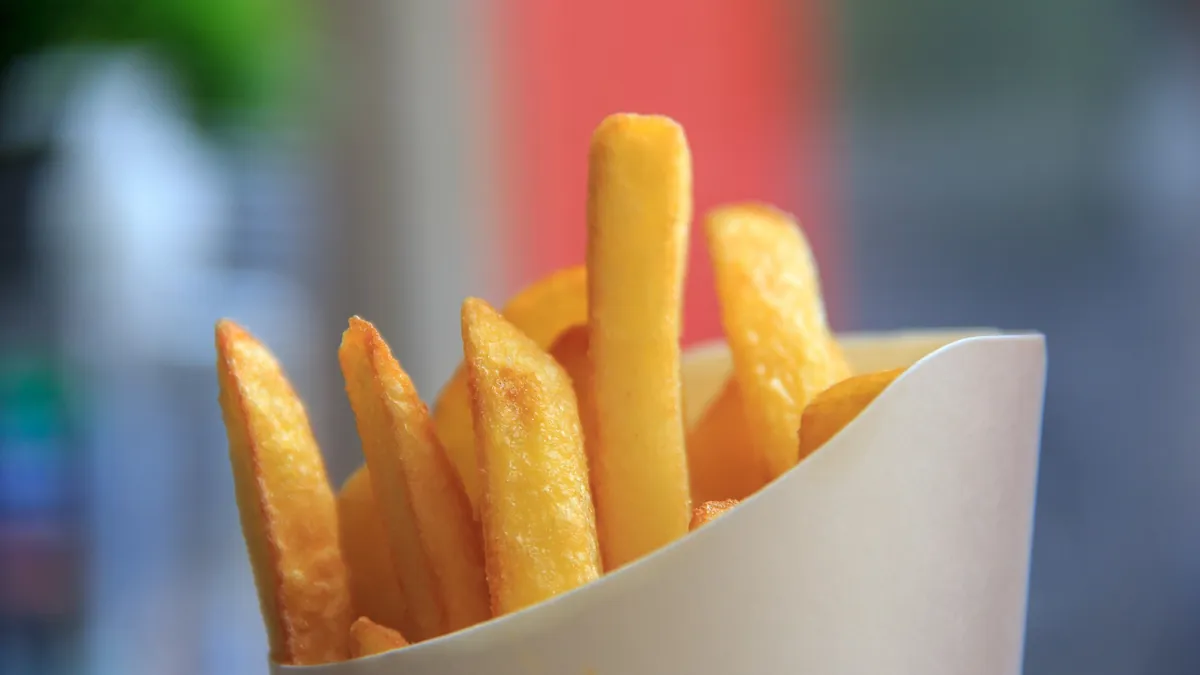
Potatoes are naturally gluten-free. Fries made from nothing but potato, oil, and salt, cooked in clean oil, are safe.
That describes very few of the fries you will actually be served. Two things get in the way: coatings added to make fries crisper, and the shared fryer. Of those, the fryer is the bigger problem, because it is invisible and because it applies even to fries with a perfect ingredient list.
For people with celiac disease, restaurant fries should be treated as unsafe unless the kitchen confirms a dedicated fryer.
The coating problem
Many commercial fries are not plain potato. To get a crisp exterior that survives freezing, transport, and reheating, manufacturers coat them — and that coating is often wheat flour or wheat starch. Some also carry seasoning blends containing malt or wheat-derived ingredients.
The words to look for on a frozen bag or a menu: battered, coated, crispy, seasoned. Any of them means the ingredient list needs reading rather than assuming.
Seasoned fries deserve their own mention. Cajun fries, garlic fries, and anything tossed in a seasoned salt are coated in a spice blend after cooking, and commercial blends often contain carriers and fillers rather than pure spice — some of them wheat-derived. Asking for plain salt only is the simplest way around this, and it is an easy request for a kitchen to honor.
Beyond the coating, some frozen fries include additives such as malt vinegar powder or modified food starch, neither of which is automatically safe.
There is a version of this that catches people who have done everything right. At some restaurant chains, the fries arrive from the supplier already carrying a flavoring, and in certain markets those flavorings include wheat-derived ingredients. When that is the case the gluten is in the product before it reaches the restaurant, which means a dedicated fryer would not make it safe. This is why the manufacturer's or chain's own allergen listing is worth checking rather than reasoning only about the kitchen.
Plain, uncoated, unseasoned fries do exist, and certified gluten-free frozen brands are widely available. In a home kitchen with clean oil, fries are a straightforward gluten-free food.
The fryer problem
This is the part that matters most, and it is worth being specific about, because it is the single most common way careful people get glutened at a restaurant.
If a kitchen fries breaded chicken, onion rings, mozzarella sticks, or battered fish in the same oil as the fries, gluten transfers into the oil and onto the fries. High heat does not destroy gluten. The oil does not clean itself between batches.
This is not a theoretical concern. A 2021 pilot study bought twenty orders of plain fries from ten restaurants in California and Ohio. Every one of those restaurants had confirmed that its fries and oil contained no gluten ingredients, and every one also confirmed that the same fryer cooked wheat-containing food.
Gluten turned up in nine of the twenty orders, from single digits up to more than eighty parts per million. Not all nine were above the twenty ppm limit; the authors concluded that roughly one order in four would fail to qualify as gluten-free. A second, more sensitive test method flagged three orders at much higher levels, one of them above 270 ppm.
Two caveats, pulling in opposite directions. The study is small and its authors call it a pilot, so one in four is an indication rather than a settled rate. But those same authors note that the tests they used under-report gluten once it has been heated, which means what was actually on the plate was probably worse than what they measured.
One in four is not a small risk. It is also a risk you cannot detect by looking at the plate or reading the menu.
Fast food
Most large fast food chains cannot offer a celiac-safe fry, and the reason is structural rather than negligent: a restaurant serving burgers on buns and breaded chicken in the same kitchen has very little chance of keeping a fryer clean.
Practices vary by chain and sometimes by individual location, and they change over time, so specific brand guidance dates quickly. The more durable advice is to ask two questions rather than one:
- Do the fries contain wheat? (Coating and seasoning.)
- Are they cooked in a dedicated fryer? (Cross-contact.)
A yes to the first or a no to the second means the fries are not safe. Asking only "are your fries gluten-free" often gets an answer based on the ingredient list alone, because staff are thinking about ingredients rather than oil.
If you have gluten sensitivity rather than celiac disease
The picture is less absolute. Tolerance for trace exposure varies considerably between individuals with non-celiac gluten sensitivity, and some people are fine with shared-fryer fries while others are not.
That is a judgment to make about your own body, ideally with a dietitian, rather than a general rule. For celiac disease, there is no comparable flexibility — shared-fryer fries are not considered safe.
What to look for
- Plain fries, with potato, oil, and salt as the only ingredients
- A dedicated fryer — confirmed, not assumed
- Certified gluten-free on frozen retail bags
- Avoid anything described as battered, coated, crispy, or seasoned unless the label says otherwise
- At home, fresh potatoes in clean oil sidestep the entire problem
One specific warning: sweet potato fries. Sweet potato carries less starch and more sugar than white potato, so it browns before it crisps and goes limp quickly. Manufacturers compensate by coating it far more often than they coat regular fries. A sweet potato fry should be assumed to be coated until the ingredient list says otherwise — the reverse of the assumption most people make, since it reads as the healthier choice. That coating is frequently corn or potato starch rather than wheat, so coated does not automatically mean unsafe. It does mean the label has to be read.
Frequently asked questions
Are McDonald's fries gluten-free?
Chain practices vary by country and change over time, so any specific answer dates quickly. In markets where fries are cooked in shared oil, they are not celiac-safe regardless of ingredients. Check the chain's current allergen information for your country rather than relying on what was true elsewhere or previously.
Does the high heat of the fryer destroy gluten?
No. Gluten survives frying temperatures. Oil that has cooked breaded food carries gluten into whatever goes in next.
Can I ask for fries to be cooked in fresh oil?
You can ask, and some kitchens will do it. In practice, changing oil mid-service is rarely possible in a busy restaurant, so a kitchen that already runs a dedicated fryer is a much more reliable option than one improvising.
If you have celiac disease and are unsure about a specific restaurant, ask the kitchen directly or check with your dietitian.
Sources
- Thompson T, et al. Gluten-Free Foods Cooked in Shared Fryers With Wheat: A Pilot Study Assessing Gluten Cross Contact. Frontiers in Nutrition, 2021. https://www.frontiersin.org/journals/nutrition/articles/10.3389/fnut.2021.652039/full — accessed 17 August 2026
- Celiac.com. Gluten Contamination of French Fries Cooked in Fryers Shared with Wheat Products. https://www.celiac.com/celiac-disease/gluten-contamination-of-french-fries-cooked-in-fryers-shared-with-wheat-products-r6196/ — accessed 20 July 2026 (secondary coverage of the study above)
- Celiac Disease Foundation. Gluten-Free Foods. https://celiac.org/gluten-free-living/gluten-free-foods/ — accessed 20 July 2026