Contents
What Is Tapioca Flour?
Tapioca flour and tapioca starch are two names for exactly the same thing. If you have seen both terms on product labels and wondered whether you were buying different ingredients, you were not. The names are used interchangeably across the food industry, and you can treat any recipe that calls for one as also accepting the other.
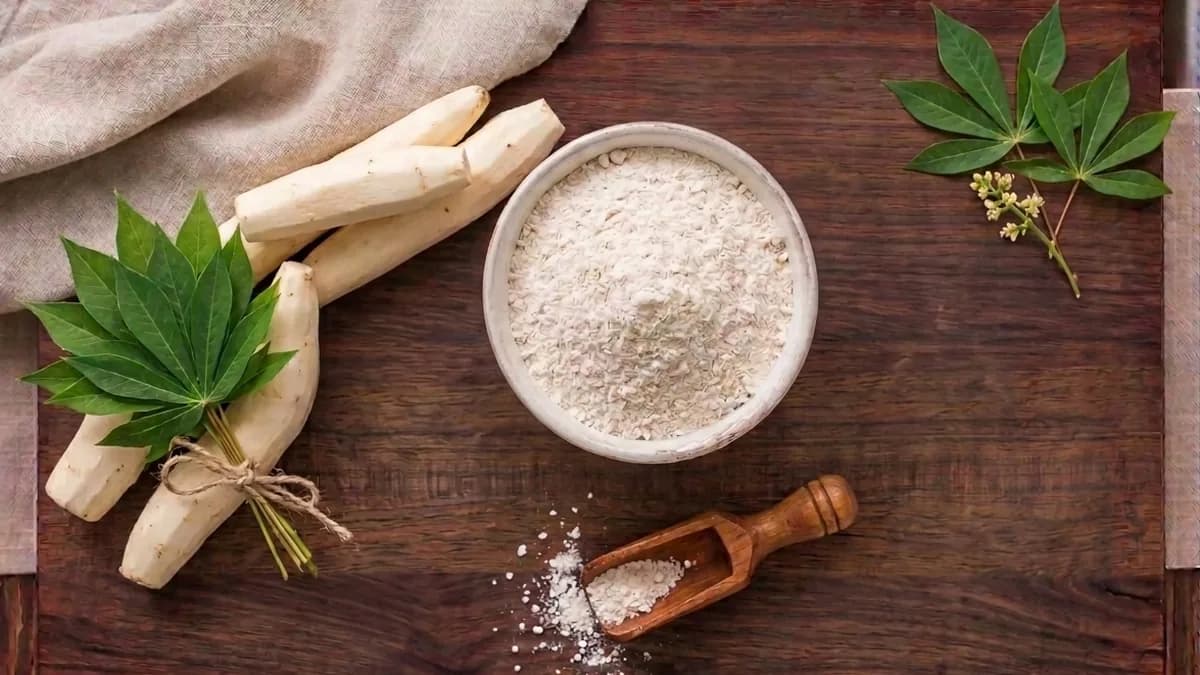
Tapioca flour is derived from cassava, a starchy tuberous root crop native to South America and now grown widely across Africa and Asia. To make the flour, cassava roots are peeled, grated, and soaked in water. The starch is then extracted from the pulp, separated, and dried into a fine, bright-white powder. The resulting product is remarkably pure starch with almost nothing else in it — no significant protein, no meaningful fat, and very little fiber.
The texture of tapioca flour is notably fine and silky, almost talc-like when you rub it between your fingers. This is one of the clues that distinguishes it from cassava flour, which is a whole-root flour made by drying and grinding the entire cassava and has a coarser, more flour-like feel. They are not interchangeable, even though they come from the same plant. Cassava flour can sometimes substitute for wheat flour in a closer to one-to-one way; tapioca flour cannot.
Nutrition Basics
Tapioca flour is, at its core, nearly pure carbohydrate. Protein content is minimal, fat is essentially absent, and fiber is negligible. It is naturally free of gluten, as cassava contains no gluten-forming proteins whatsoever.
Because it is such a refined starch, tapioca flour has a high glycemic index. It digests quickly and raises blood sugar faster than whole-grain flours or even many other starches. This is not a concern in typical baking quantities, where tapioca flour is used in small amounts as part of a blend, but it is worth noting for anyone tracking glycemic load carefully.
For exact figures, see USDA FoodData Central.
Tapioca flour does not contribute meaningful amounts of vitamins or minerals. It is not a nutritional powerhouse. Its value in gluten-free baking is entirely functional rather than nutritional — it is there to do a structural job, not to add nutrients. Some bakers view this neutrality as an advantage, since tapioca flour adds no competing flavors or colors to a recipe.
Baking Behavior
This is where tapioca flour genuinely earns its place in the gluten-free pantry. Its functional properties are distinctive and difficult to replicate with other starches.
The most notable characteristic of tapioca flour in baking is the chewiness and elasticity it contributes. When heated in the presence of moisture, tapioca starch gelatinizes and creates a slightly stretchy, springy texture. If you have ever eaten a chewy gluten-free bread or a pizza crust with a pleasant pull to it, tapioca flour was likely part of the formula. It mimics, at least partially, the elastic quality that gluten provides in conventional baked goods.
Tapioca flour is also an excellent thickener. It produces smooth, glossy sauces and gravies with a texture that is clear rather than cloudy. It works at lower temperatures than some other starches and produces a particularly clean mouthfeel. For pie fillings and fruit compotes, tapioca starch creates a gel that holds its shape well without the slight chalkiness that can come from overusing cornstarch or arrowroot.
As a binder in gluten-free baked goods, tapioca flour helps hold together batters and doughs that would otherwise crumble. It works synergistically with other flours — rice flour, sorghum flour, almond flour — helping to create a more cohesive structure.
The main pitfall with tapioca flour is using too much of it. Overuse leads to gummy, dense, almost gluey results. A muffin with an excess of tapioca flour can feel sticky on the palate and have a rubbery interior. Most experienced gluten-free bakers cap tapioca flour at around 20 to 30 percent of the total flour weight in a blend, using it as a supporting ingredient rather than a primary one.
Substitution Ratios
Tapioca flour is almost never used as a straight one-to-one substitute for wheat flour. Because it is pure starch with no protein structure of its own, it cannot replicate the full behavior of wheat flour when used alone. The result would be dense, gummy, and structurally weak.
Instead, tapioca flour works as a component in a gluten-free flour blend. A common approach is to combine it with a higher-protein gluten-free flour such as brown rice flour, sorghum flour, or a legume-based flour, plus a starch like potato starch or arrowroot, in varying ratios depending on the application. Many commercially available gluten-free all-purpose flour blends already include tapioca flour as one of their starch components.
As a thickener replacing cornstarch, tapioca flour performs well at roughly a one-to-one substitution by volume, though some cooks prefer using slightly more tapioca starch since cornstarch is a bit more powerful per gram. Tapioca is generally preferred over cornstarch in recipes that will be frozen and reheated, because it holds up better and does not become spongy or watery after freezing.
For thickening in place of all-purpose wheat flour (such as in a roux or white sauce), use roughly half the amount of tapioca starch, as it is a more concentrated thickener.
Cross-Contamination Notes
Cassava itself is an inherently gluten-free crop. There is no botanical relationship between cassava and wheat, barley, or rye, and the plant contains none of the proteins that cause problems for people with celiac disease or gluten sensitivity. In that sense, tapioca flour starts life as one of the lower-risk gluten-free ingredients.
That said, inherently gluten-free does not automatically mean safe for every person who needs to avoid gluten. The risk lies not in the ingredient itself but in how it is processed and packaged. Facilities that handle tapioca flour may also process wheat-based products, and shared equipment or shared production lines can introduce cross-contamination. Bulk bins at grocery stores present a similar risk.
For anyone with celiac disease or a serious gluten sensitivity, the reliable approach is to look for tapioca flour that is certified gluten-free by a recognized third-party organization. Under FDA rules any product labeled "gluten-free" must contain less than 20 parts per million of gluten, but that claim rests on the manufacturer's own assurance rather than mandatory testing. Certification adds independent verification and facility audits on top of it, and some certifiers work to a stricter limit. Reading labels for facility statements — phrases like "processed in a facility that also handles wheat" — is a worthwhile habit even for products that seem inherently safe.
When sourcing tapioca flour, brands that specialize in gluten-free products and dedicate their facilities to gluten-free production are generally the safest choice for the most sensitive individuals.
Sources
- U.S. Food and Drug Administration. Gluten and food labeling — accessed 24 August 2026